
Web handling is the process technology of moving a web — a structure that is long, wide, thin, and flexible — through a machine line, encompassing unwinding, guiding, tension control, and winding. The primary goal is to present the web correctly to each process step: flat, straight, at the correct speed, and under the proper tension. Failure to do so leads to defects like wrinkles, misalignment, and tension transients that compound as the material moves downstream.
Diagram of a full web path from unwind to rewind
Key Terms
- Web path
- The actual route or position of the web centerline as it travels from the unwind to the rewind.
- Span length
- The distance the web travels between two support elements, such as rollers. Longer spans are more sensitive to wrinkling and path control errors.
- Steering
- The active correction of the web's lateral position using actuators and sensors to keep it aligned with a target centerline or edge.
- Spreading
- Applying cross-direction tensile stresses to move web edges outward, removing wrinkles or separating slit lanes.
Substrate Basics
Each substrate type requires the line to be tuned differently — the tension, roller configuration, and speed that work well for a heavy paperboard won't necessarily work for a thin polymer film.
- Film
- Typically thin and elastic; prone to permanent deformation or "neck-in" (narrowing) if tension is too high.
- Nonwovens
- Often porous and lightweight; easily damaged by compression in nips and require low tension to avoid pulling the fiber structure apart.
- Paper
- Extremely sensitive to moisture and humidity, which causes dimensional changes, curl, and an increased risk of web breaks in dry environments.
- Metal foil
- Very thin and stiff; has a low elastic limit, meaning it will permanently crease or dent if subjected to even minor tension or alignment errors.
Rollers, Drives & Nips
A web travels over a series of rollers between unwind and rewind, each serving a specific purpose.
- Dancer roller
- A moveable roller that accumulates or dispenses web to absorb speed mismatches and maintain a constant tension setpoint.
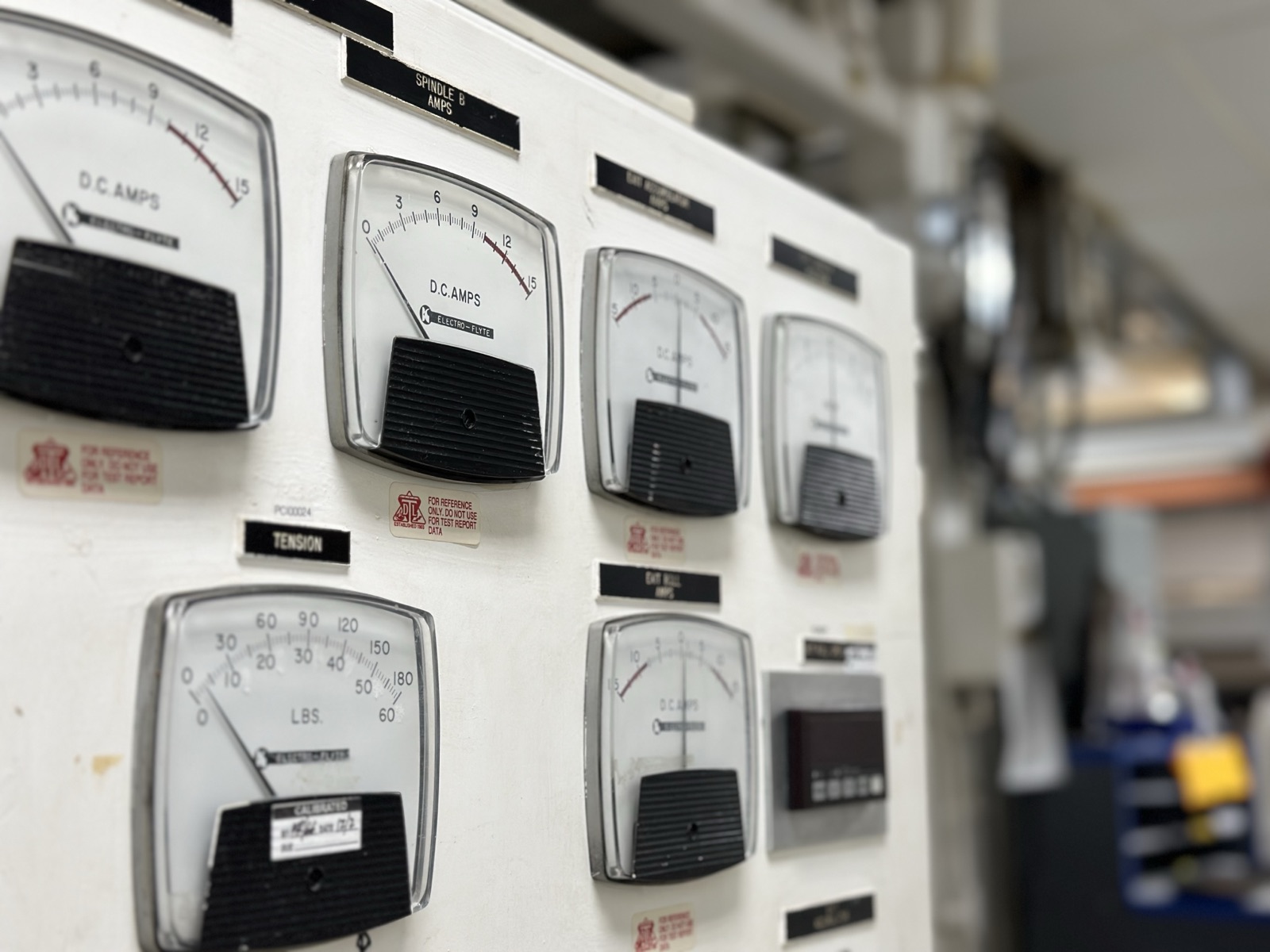
- Tension roller (load cell)
- Mounted on transducers to measure the actual tension force of the web for feedback control.
- Driven roller
- Powered by a motor to provide the motive force required to transport the web and separate different tension zones.
- Steering guide
- A specialized assembly that pivots a roller in the plane of the incoming web to correct lateral tracking errors based on the Normal Entry Law.
Nip points — where two rollers press the web between them — are critical for tension isolation but are among the most dangerous hazards in web handling. Every in-running nip can pull in fingers, hair, or loose clothing. Guarding and lockout/tag-out (LOTO) procedures are the primary defenses.
Close-up of a nip point
Traction & Tension Basics
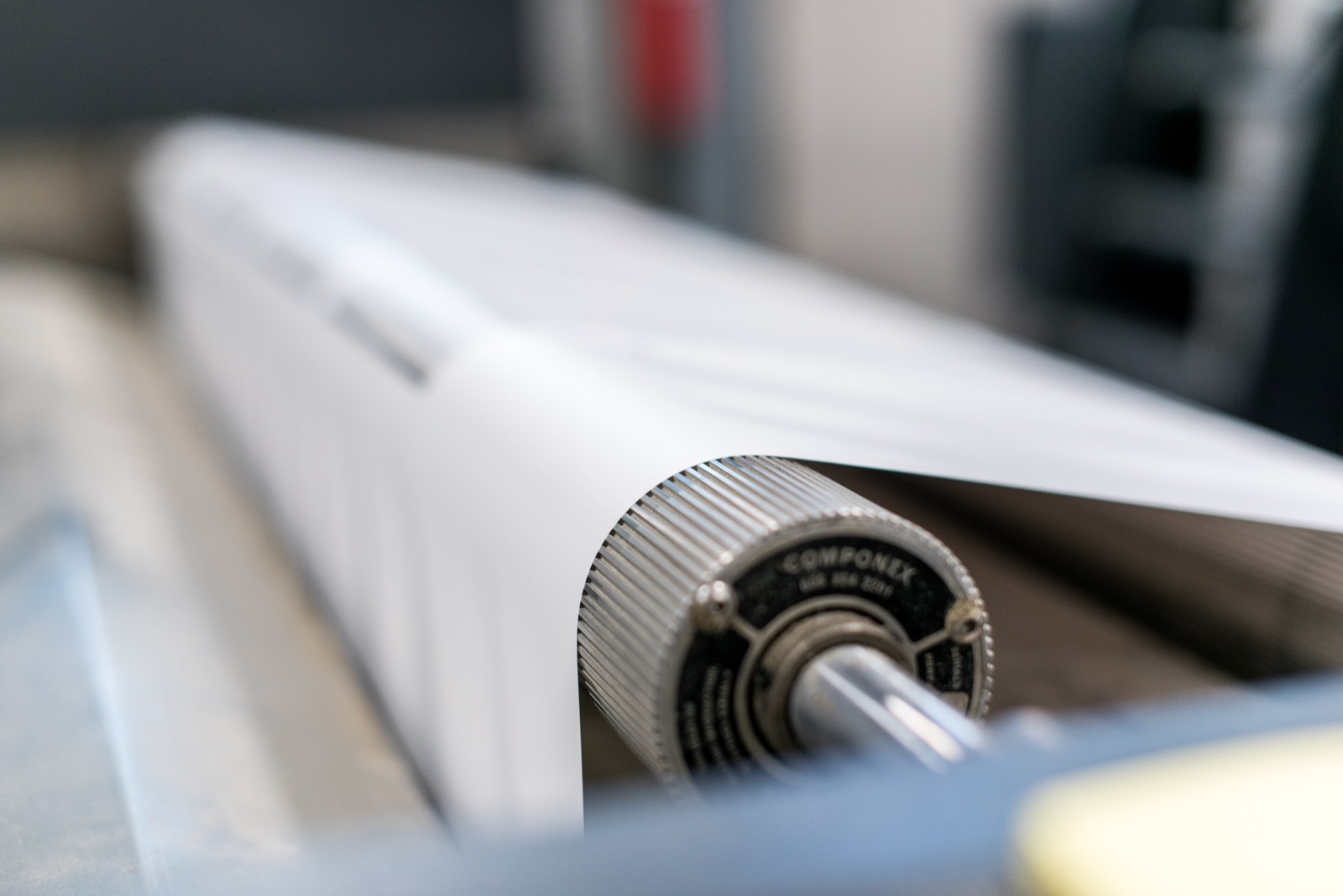
The capstan (belt) effect governs the maximum tension ratio a roller can sustain without the web sliding — governed by coefficient of friction and wrap angle, where increasing either exponentially increases grip. At high line speeds, air entrainment (hydroplaning) occurs when a thin film of air dragged between the web and roller floats the web, causing total loss of traction; grooved or textured rollers vent this air to maintain contact.
Guides & the Normal Entry Law
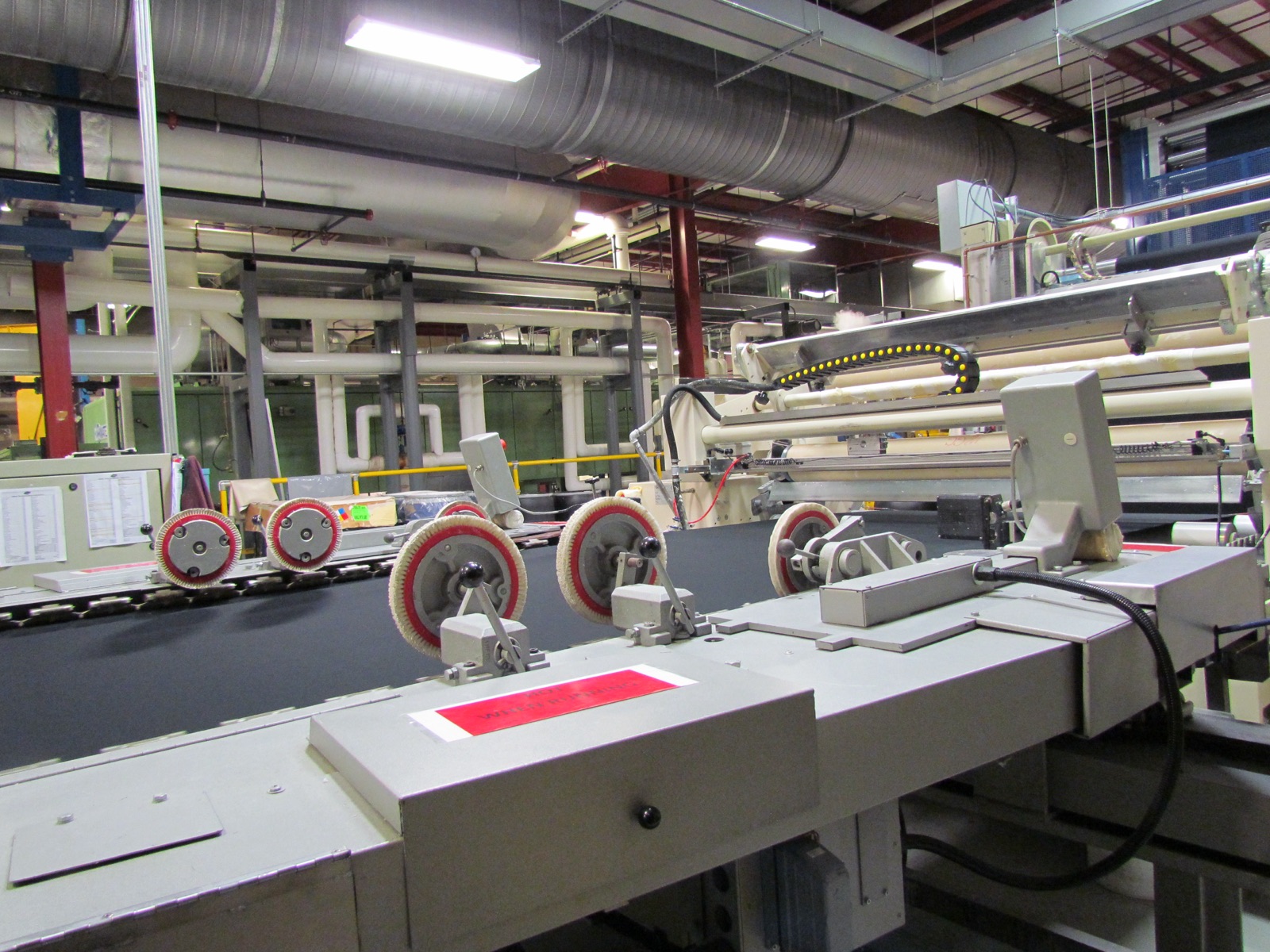
Guiding systems use the Normal Entry Law — a web in traction will always attempt to enter a downstream roller at a 90-degree angle to that roller's axis — to manage lateral position. Active systems use a sensor (infrared, ultrasonic, or pneumatic), a controller, and an actuator. A critical best practice: place the edge sensor as close as possible to the moving roller to avoid "deadly delay" control lag.
Web Defects
- Troughs
- Out-of-plane wavy patterns in open web spans. An early warning that the web is approaching the buckling limit.
- Wrinkles & ridges
- A ridge is a lack of flatness as the web wraps a roller. If severe, it can collapse into a permanent crease — especially damaging to foils and thin films.
- Baggy web
- Machine-direction tension variations across the width, where some lanes are longer or looser — typically caused by persistent CD variations in thickness or moisture.
Wrinkled web
Baggy web
Winding
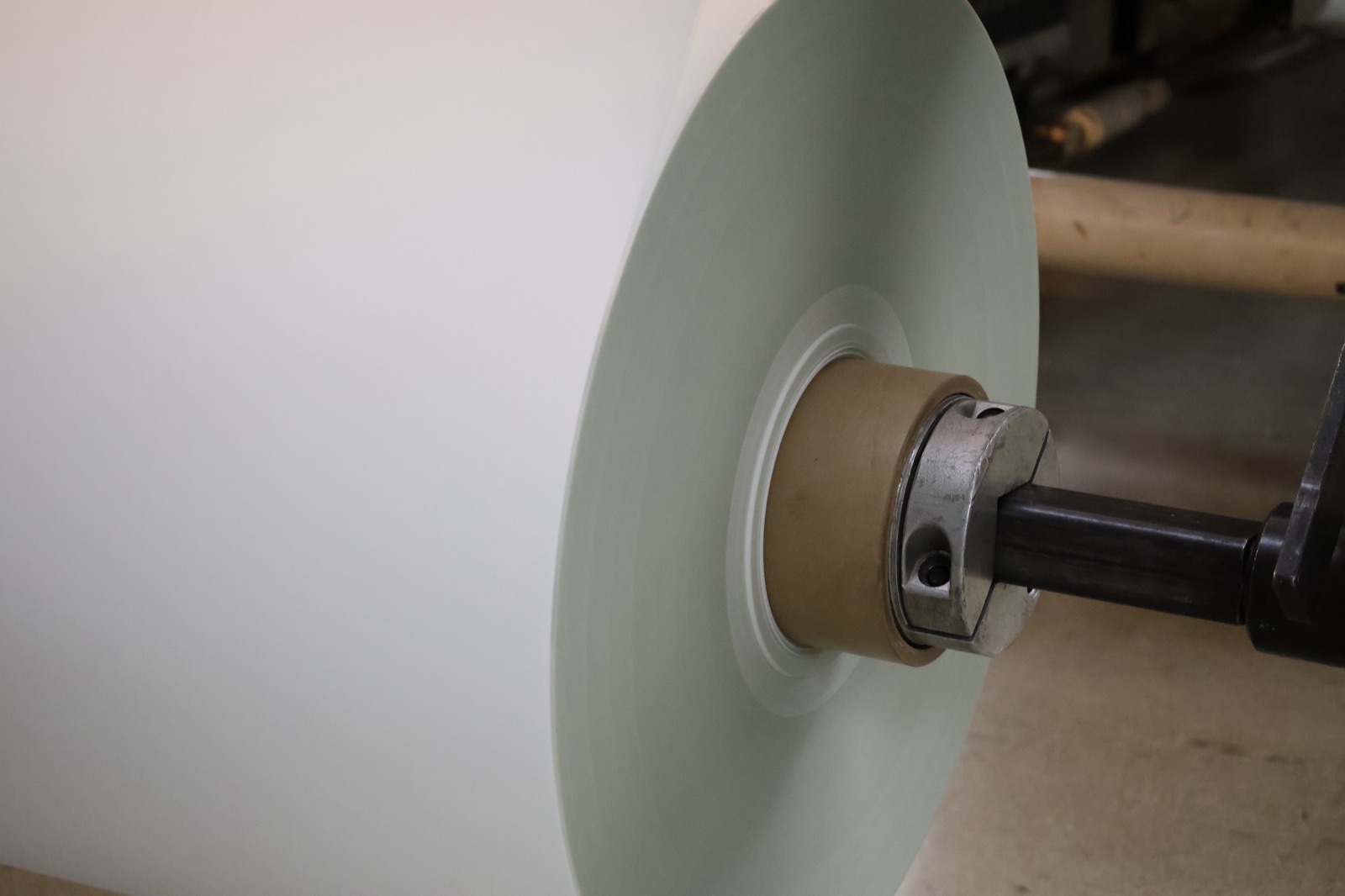
A properly wound roll must have sound internal structure. Well-wound rolls typically employ tapered tension — reducing tension as diameter increases — to prevent outer layers from crushing inner layers. Common winding defects include telescoping (axial layer shift), starring (spoke-like buckles near the core), and crushed cores from excessive radial pressure.
Web handling also involves detailed considerations around winding models, finite element analysis, sensor calibration, and specific defect troubleshooting. For process-specific guidance, the Technical Advisory Panel and technical library are the right next step.